
Box Cricket Rules and Ground Dimensions: A Plain Guide
Box cricket has no governing body, so no official pitch size or rulebook exists. Here is what venues settle on in practice — dimensions, team size, overs and the house rules worth confirming first.
Quick answer
What are the rules and dimensions of box cricket?
Box cricket has no governing body, so no single rulebook or official pitch size exists — every venue sets its own. In practice a side is 6 to 8 players, innings run 5 to 8 overs, and the ground is netted on all sides so the ball stays in play. House rules decide catches, boundaries and net hits.
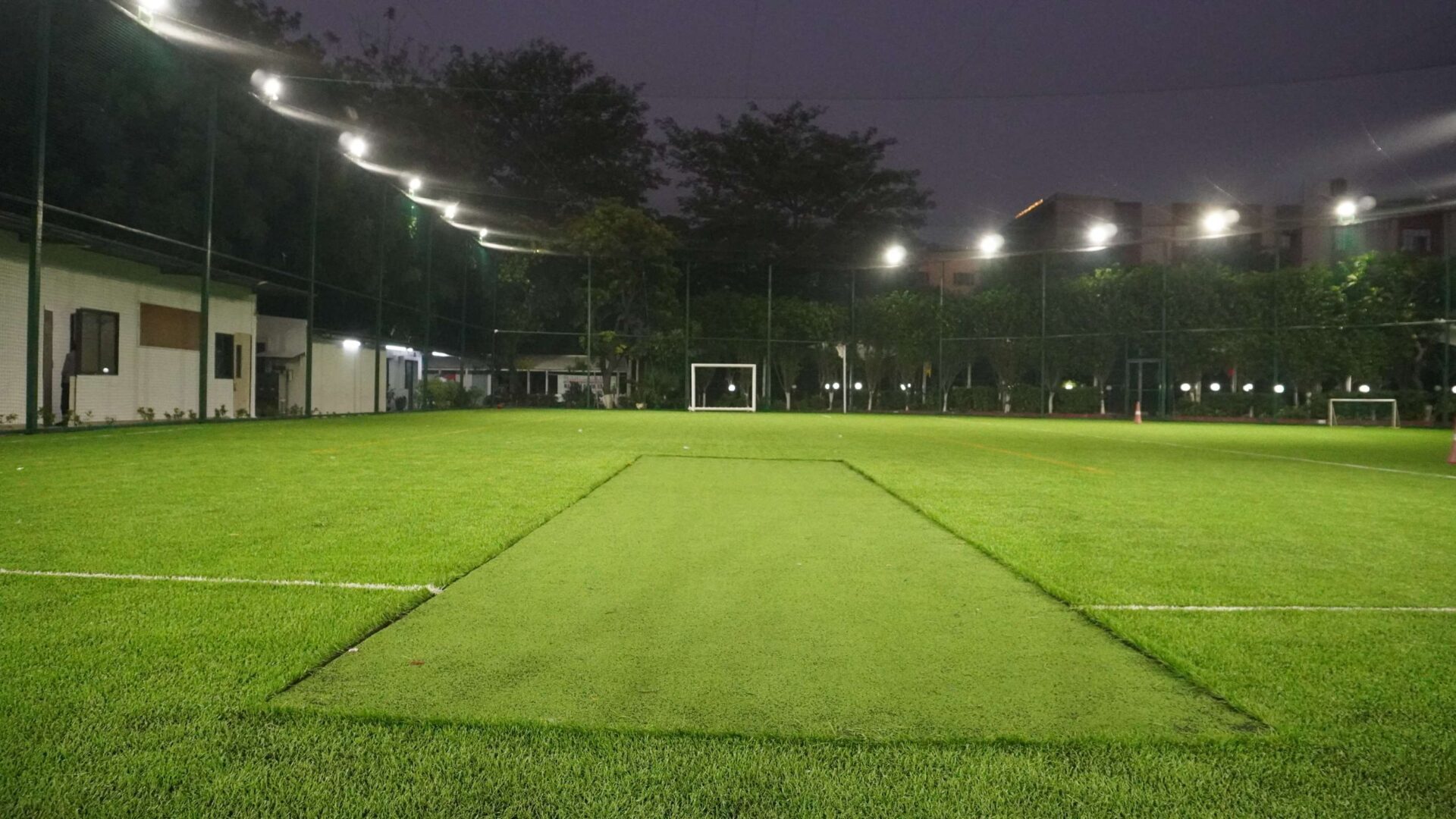
Box cricket is the format that made cricket bookable by the hour: a short, fast game played inside an enclosure netted on every side, so the ball never leaves the ground and a full match fits into an evening slot. It is the most-booked format at an urban turf — and also the one with the most confusion about “the rules”, because there is no single rulebook to point at.
There is no governing body — and that matters
Unlike football or badminton, box cricket has no international or national federation. No organisation codifies its pitch size, over count or dismissal laws. Every venue and every tournament organiser writes its own house rules. So when you read a confident “official box cricket dimensions” online, treat it as one venue’s convention, not a standard. The honest version is: the numbers below are what most grounds settle on, not rules handed down from anywhere.
Ground dimensions (by convention)
A box cricket ground is defined by its netting, not by a chalk boundary. Common enclosures run roughly 80×40 ft at the smaller end to about 100×50 ft for a fuller game, with high side and roof nets to keep the ball live. The pitch itself is shorter than a standard 22-yard strip, because the whole point is a compressed, high-tempo game in a contained space.
Because the nets are the boundary, the enclosure’s shape decides how the game plays far more than any published figure. A longer box rewards running; a tighter one turns every firm shot into a chance.
Team size and overs
- Players a side: usually 6 to 8. Smaller sides on a smaller box.
- Innings length: commonly 5 to 8 overs each — short enough to play two full innings inside an hour or two.
- Batting: many formats retire a batter at a set score, or bat in pairs, so everyone gets time in the middle.
Common house rules
These vary by venue, and the right move is always to confirm them before the first ball:
- Hitting specific nets (side, roof, or the net behind the keeper) can mean out, a dead ball, or a fixed number of runs — venues differ.
- One-hand-one-bounce catches are often allowed to keep dismissals frequent.
- Catches taken off the net are usually not out in box cricket — but this is exactly the kind of rule a venue may reverse, so ask.
- Last-man-bats and “last pair” rules keep short innings competitive to the end.
Box cricket is not indoor cricket
This is the distinction most guides miss. Indoor cricket is a genuinely codified sport, governed by the World Indoor Cricket Federation and Cricket Australia, with a fixed court, fixed team size and a proper rulebook. Box cricket borrows its “play off the nets” feel but keeps none of its standardisation. The contrast is the clearest way to see what box cricket is — and isn’t.
| Aspect | Box cricket (convention) | Indoor cricket (codified) |
|---|---|---|
| Governing body | None | WICF / Cricket Australia |
| Playing area | ~80×40 to 100×50 ft, netted | ~28–30 m × 10.5–12 m, netted |
| Players a side | 6–8 (varies) | 8 (typical), 6 minimum |
| Innings | 5–8 overs (varies) | 16 overs |
| Catches off the net | Usually not out (house rule) | Legal |
| Scoring | House rules | Zone scoring; −5 runs per dismissal |
Box cricket at Squats Que
Our box cricket ground in Dilshad Garden is fully netted and floodlit, and open around the clock every day. The ground holds 20–22 players comfortably — that is a capacity figure for the space, not a team size. Sides are still the usual 6 to 8; the extra room means squads, rotations and spectators fit without crowding the box.
We settle the house rules with you before you start, so nobody argues about a roof-net catch mid-over. To lock a slot, tell us your date, time, duration and numbers on WhatsApp from the book a slot page and we will confirm it back with a quote.
Related questions
No. Box cricket has no governing body, so there is no official size. By convention grounds run roughly 80×40 to 100×50 ft, netted on all sides, but the figure varies from venue to venue.
Usually 6 to 8 a side, decided by the venue or tournament. The smaller the box, the smaller the sides tend to be.
Usually not — a ball off the side or roof net is typically not a catch. But this is a house rule, and some venues reverse it, so confirm before you start. (In codified indoor cricket, net catches are legal.)
No. Indoor cricket is a codified sport with a rulebook, governed by the World Indoor Cricket Federation and Cricket Australia. Box cricket is an informal netted format with no governing body and no fixed dimensions.
Commonly 5 to 8 overs per innings, set by the organiser so two innings fit into a short slot.
The ground holds 20 to 22 players comfortably — that is the capacity of the space, not the team size. Sides are still the usual 6 to 8; the room is for squads, rotations and spectators.