
Badminton Court Dimensions and Net Height (BWF Rules)
The full BWF specification for a badminton court — length, singles and doubles width, net height, service lines and the ceiling clearance that makes an indoor court necessary.
Quick answer
What are the official badminton court dimensions?
Under BWF rules a badminton court is 13.4 m long and 6.1 m wide for doubles, narrowing to 5.18 m for singles. The net stands 1.55 m high at the posts and 1.524 m at the centre. The short service line sits 1.98 m from the net, and all lines are 40 mm wide.
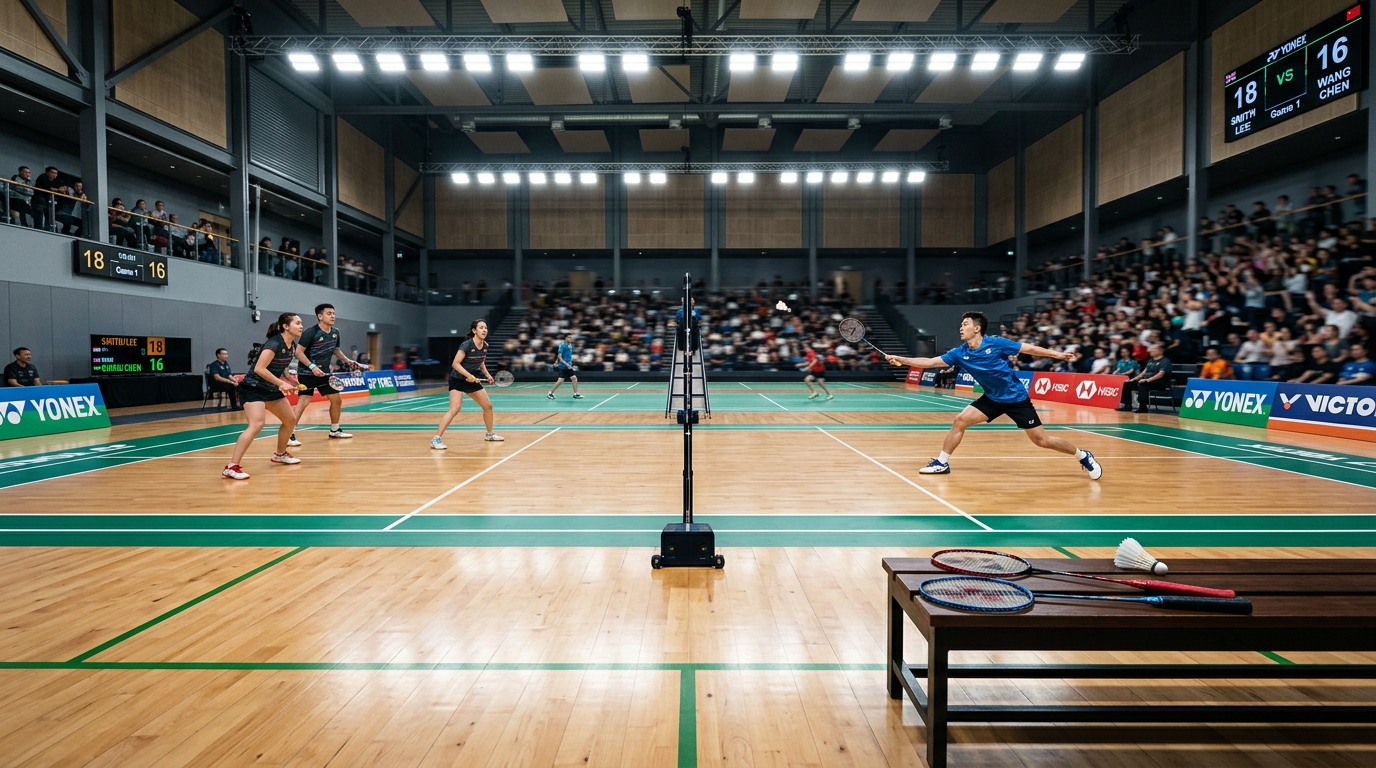
Badminton is one of the few sports on a booking sheet with a fully codified court, so “what are the dimensions” has a real answer rather than a venue’s opinion. The measurements below come from the Badminton World Federation (BWF) Laws of Badminton — the same specification used from a local hall to the Olympic Games.
Court dimensions
A badminton court is a single rectangle with two sets of side lines: the outer pair for doubles, the inner pair for singles. The length never changes.
| Measurement | Value |
|---|---|
| Court length | 13.4 m |
| Width (doubles) | 6.1 m |
| Width (singles) | 5.18 m |
| Full-court diagonal | 14.723 m |
| Line width | 40 mm |
The lines are part of the court: a shuttle landing on a line is in. At 40 mm wide they are deliberately thick enough to judge from the back of the court.
Net height
The net is not level. It is 1.55 m high at the posts and dips to 1.524 m at the centre — a small, deliberate sag. The posts sit on the doubles side lines, even during singles.
Service lines
- Short service line: 1.98 m from the net. A serve must clear it.
- Doubles long service line: 0.76 m inside the back boundary — the doubles serve court is shorter.
- Centre line: splits each side into left and right service courts.
Why the ceiling height matters
The court is only half the venue. Badminton is played with high, floated clears, so the clear height above the court is part of the specification. BWF guidance is a minimum of about 9 m of unobstructed height, with tournament halls built to 12 m. Anything lower and a good clear hits the roof — which is precisely why a serious court has to be indoors with real headroom, not a converted low-ceiling room.
Indoors is not a preference — it is the sport
A shuttlecock weighs under 5 grams and is shaped to catch air. Even a light breeze ruins its flight, which is why competitive badminton is always indoor. An indoor court also means the game plays identically in July heat, December cold and monsoon rain — the conditions never change.
That is the case for our indoor badminton courts: built to BWF dimensions, roofed, and lit for play at any hour. Players across the east of the city reach them easily — see badminton courts for East Delhi for how to get there. When you are ready, send your slot on the book a slot page.
Want to play Badminton?
Squats Que has indoor badminton courts in Dilshad Garden, East Delhi, built to standard BWF dimensions with synthetic flooring and anti-glare lighting. Being indoors means no wind and identical conditions in any weather. Courts are open 24 hours a day, every day, and bookable by the hour on WhatsApp.
Read next
You Can See Everything 2026 7𝟸0𝚙 x265 Subtitles YIFY
🔧 Digest: 3e79b7a88e89490a0a353392387cd711 • 🕒 Updated: 2026-09-27 Verify Codec: 10-bit depth required Audio Track: DTS:X needed to prevent sound spatialization issues Size: high-quality BDRip 40 GB…
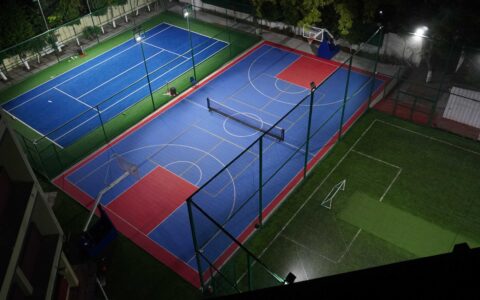
Pickleball vs Badminton vs Tennis: Courts, Nets and Rules Compared
Pickleball and badminton share almost the same court, but the net height, the kitchen rule and the equipment change everything. A clear comparison with tennis, including…
Related questions
A badminton court is 13.4 m long. It is 6.1 m wide for doubles and 5.18 m wide for singles — the length is the same for both.
The net is 1.55 m high at the posts and 1.524 m at the centre, where it dips slightly.
BWF guidance is a minimum of about 9 m of unobstructed clear height, with tournament venues built to 12 m, so high clears are not obstructed.
The length is identical. Doubles uses the full 6.1 m width; singles uses the narrower 5.18 m inner side lines. The doubles serve court is also shorter at the back.
The short service line is 1.98 m from the net. A serve must land beyond it.
Casually, yes, but the shuttlecock weighs under 5 g and is ruined by even a light breeze, so competitive badminton is always played indoors.