
7-a-Side vs 11-a-Side Football: Pitch Size, Rules and What Changes
Eleven-a-side is codified by IFAB; seven-a-side has no single global standard. What genuinely changes between the two formats — pitch, goals, offside, match length — and what each venue decides for itself.
Quick answer
What is the difference between 7-a-side and 11-a-side football?
Eleven-a-side is the codified game: a 100 to 110 m pitch, 7.32 m goals, two 45-minute halves and the offside law. Seven-a-side has no single global standard — pitches run roughly 45 to 55 m long, there are seven players including the keeper, halves are shorter, and most small-sided competitions play no offside.
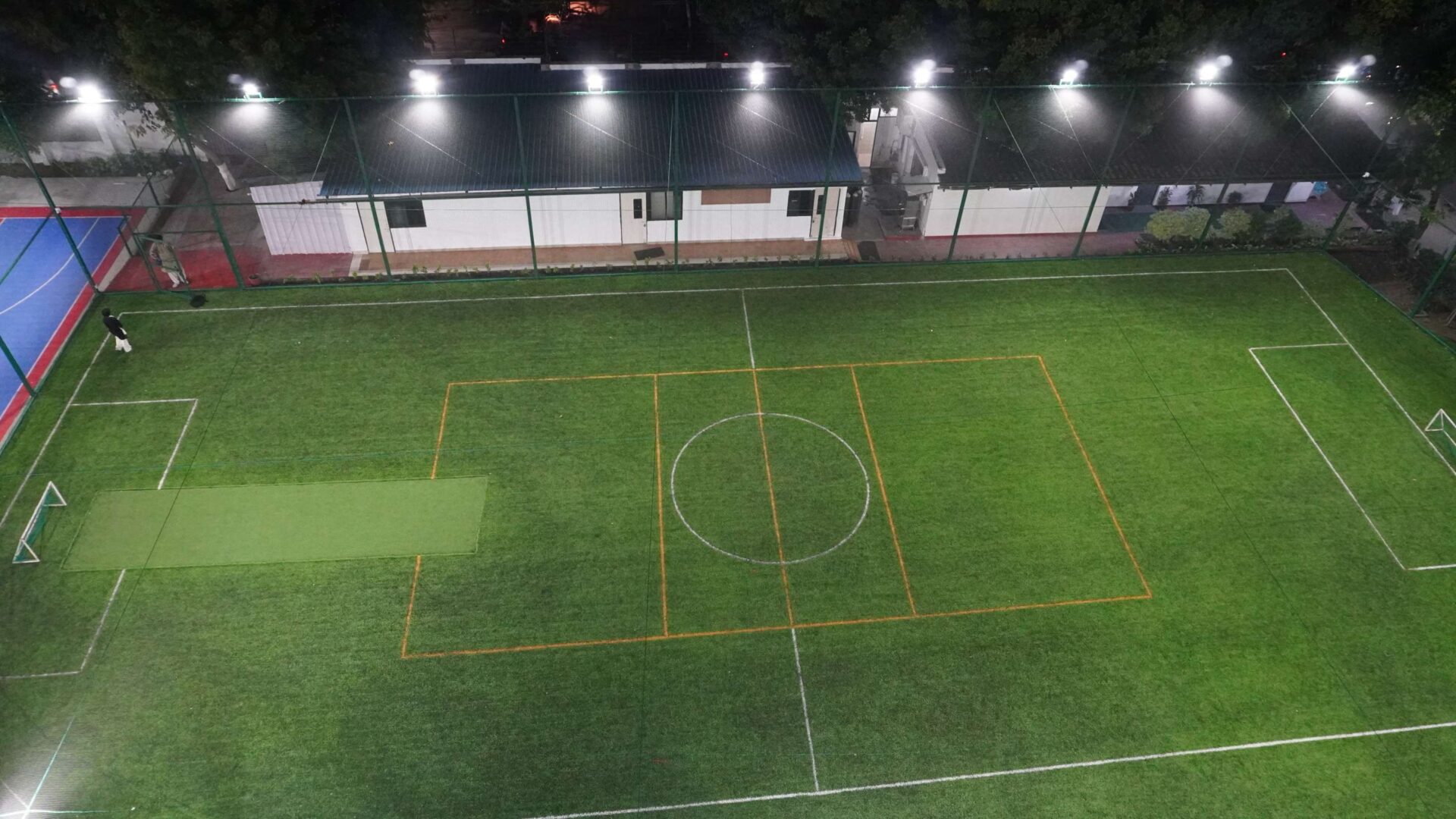
“Football” on a booking sheet can mean two quite different games. Eleven-a-side is the codified sport with a rulebook; seven-a-side is the fast, turf-friendly format most people actually book after work. Knowing what changes between them — and what is genuinely standardised versus what each venue decides — saves a lot of confusion.
11-a-side is the codified game
Eleven-a-side football is governed by the IFAB Laws of the Game, the specification FIFA plays under. The key numbers:
- Pitch: 90–120 m long by 45–90 m wide. For international matches the range tightens to 100–110 m by 64–75 m.
- Goal: 7.32 m wide by 2.44 m high, measured inside the posts.
- Ball: size 5, circumference 68–70 cm, weight 410–450 g.
- Match: two halves of 45 minutes, with a half-time break of no more than 15.
- Team: 11 players including the goalkeeper; the match cannot continue if a side drops below seven.
- Offside applies.
7-a-side has no single global standard
Here is the honest part most guides skip: there is no IFAB or FIFA specification for a 7-a-side pitch. The format is governed by national associations and individual competitions, so the dimensions genuinely differ depending on whose rules you are playing under.
| Aspect | 11-a-side (IFAB) | 7-a-side (no global standard) |
|---|---|---|
| Players | 11 incl. goalkeeper | 7 incl. goalkeeper |
| Pitch | 90–120 × 45–90 m | ~45–55 × 30–37 m (association-dependent) |
| Goal | 7.32 × 2.44 m | Smaller; varies by competition |
| Offside | Yes | Usually not |
| Halves | 2 × 45 min | Shorter; set by the organiser |
| Governed by | IFAB Laws of the Game | National FA / the competition |
The one thing that is constant across every 7-a-side code is the number in the name: seven players, and that seven includes the goalkeeper. Everything else — pitch size, goal size, offside, match length — is set locally. As a rough guide, England’s FA runs small-sided 7v7 at around 55×37 m; Australia’s youth format is nearer 45×35 m. Treat those as examples of the spread, not the rule.
A word on the turf itself
People often ask for an “official” artificial-turf pile height. There isn’t one in the way there is for a pitch line. FIFA’s quality programme certifies turf on how it performs — ball roll, bounce, grip — rather than mandating a millimetre figure. In practice, football turf pile sits in a roughly 40–60 mm band. Anyone quoting a single exact “regulation” height is stating a convention, not a law.
Which format suits you
Seven-a-side is the natural fit for a turf booking: fewer players to gather, a shorter game, and end-to-end action. It is the format most week-night groups play. Eleven-a-side needs a full-size ground and a bigger squad, and comes into its own for organised matches and tournaments.
Our football turf in Dilshad Garden is floodlit and open at any hour, set up for small-sided games through to larger matches. Planning something bigger — a league night or a corporate tournament? See tournaments and events. To book, send your date, time, duration and numbers from the book a slot page.
Want to play Football Turf?
Squats Que runs a floodlit artificial-grass football turf in Dilshad Garden, East Delhi that supports both 7v7 and 11v11 formats, with proper goalposts and pitch markings. It is open 24 hours a day, every day, and slots are booked by the hour over WhatsApp.
Read next
Street Fighter 2026 WEB-DL UltraHD Atmos 𝐃𝐨𝐰𝐧𝐥𝐨𝐚𝐝 .t𝐨rr𝐞nt
🧩 Hash sum → f74c88d28ae39aa1d0bc34b2ffd39999 — Update date: 2026-09-26 Verify Video: high-profile profile for heavy scene processing Audio Track: DTS:X needed to prevent sound spatialization issues…

Playing Sports at Night in Delhi: Where and Why It Works
Night is often the best time to play in Delhi — cooler, after work, under lights. What makes a venue genuinely work after dark, and how…
Related questions
There is no global standard. Seven-a-side is set by national associations and competitions, so pitches vary — roughly 45 to 55 m long by 30 to 37 m wide, depending on whose rules you play under.
Seven per side, and that seven includes the goalkeeper. It is the one figure constant across every 7-a-side code.
Usually not — most small-sided 7v7 competitions play without offside. But the competition's own rules decide, so check.
Under IFAB, 90 to 120 m long by 45 to 90 m wide. For international matches the range tightens to 100 to 110 m by 64 to 75 m.
A full-size 11-a-side goal is 7.32 m wide and 2.44 m high, measured inside the posts. Seven-a-side uses smaller goals that vary by competition.
Adult 11-a-side uses a size 5 ball, circumference 68 to 70 cm. Youth and some small-sided formats use smaller sizes.